Wednesday, 11 March 2015

The Great Train Robbery (1903) [Short Film]


A charming and highly
impressive relic of cinema's
formative years.


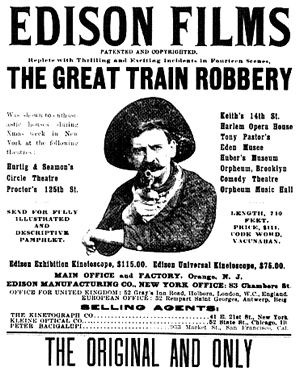
The Great Train Robbery is one of the most significant films in early American cinema. It formed the early DNA of what would become both the Western and Crime genres and signaled film's growing influence outside of France, where the Lumiere brothers and Georges Melies had already left a vital mark. Aside from it's indescribable historical significance, The Great Train Robbery remains a highly entertaining little window into the years before The Birth of a Nation revolutionized film into what we know today.

The thing that surprised me the most about this film was how exciting and violent it was. I am quite shocked that such violence and daring threat was accepted by people in 1903, however I am very glad because these primitive scenes of violence and action set a tradition with American cinema. I was also greatly surprised by some of the film's shot compositions, as they showed a greater degree of visual literacy than I was expecting from this period. The final shot in particular is extremely memorable, and has become almost as iconic as Melies's 'moon shot'.

Overall, although I do not feel the same level of raw enchantment and majesty from this film as I do with A Trip to the Moon, it remains a significant and entertaining relic from cinema's primordial ooze.

By Jack D. Phillips
A Zoom Film Review

Tuesday, 10 March 2015

My Opinion of the Oscars 2015: Best Cinematography/Best Picture

Best Cinematography

I think it safe to say that Birdman is the obvious winner in this category. It totally deserves this prestigious (giggle, the Academy has no prestige) award and is one of the most ambitiously shot films of the last few years. Aside from the winner, I can attest to the beautiful cinematography in The Grand Budapest Hotel and am very interested in both Ida and Mr Turner, which both seem to have a lot of personality within their cinematography. I am somewhat annoyed that neither Gone Girl or Nightcrawler received any recognition, however it was ignored in almost every other category.

Best Picture

The biggest controversy concerning the largest accolade of the ceremony centers around Birdman winning over Boyhood. As I have not seen Boyhood  (although I dearly want to) and so I cannot way into this debate, however I would like to say that the bickering seems quiet childish to me. Aside from that this category was missing several of the year's best film's in my eyes, including Gone Girl, The Babadook and Nightcrawler, however none of these films fit within  the Academy's irritating tunnel vision when it comes to the art-form it claims to represent. I adore Birdman and so I am very happy that it won the award, and even if I liked Boyhood more it would remain a worthy victor in my eyes.

By Jack D. Phillips

Monday, 9 March 2015

Der Golem (1920)


Flawed in some
aspects, yet still
a potent and fascinating
slice of expressionist
horror.


Der Golem ist sehr gut!

Literally two years of GCSE German on display there people, pity me.  Anyway, Der Golem is a very effective and highly influential  German silent horror film. It is perhaps most well known for it's impressive use of expressionist production design and the large role it played upon the seminal filmmaker James Whale in the following decade.

Der Golem is sadly the only remaining film in an intended trilogy of fantasy/horror films based around the titular character, all made by actor/director Paul Wegener.  Wegener stars in this film as the Golem himself, and is able to hold the film together with his highly entertaining portrayal of the Jewish myth. Wegener portrays the Golem exactly as I imagined, treading a fine line between an animated statue and a sapient, bestial monster.  Wegener's excellent physical and facial acting, along with the top-notch makeup, make this character such an icon of the silent era. However, one of the film's largest issues stems from how the film underutilises it's titular character, for the Golem is truly the most compelling aspect of the entire film.

Outside of the Golem itself, the film boasts some truly inspired sets, some of the most ambitious and grandiose examples of German expressionism out there. The way in which these sets interact with the film's incredibly eerie and effective lighting is worth the viewing by itself. The costume design is also quite charming, acting as an elegant extension on the film's themes of class and prejudice and are also appropriately exaggerated to match the wild sets and environments..

Despite these various high positives, the film suffers from several key flaw beyond the surprising lack of the titular Golem. These namely come in the form of length and pacing. I feel the film is quiet a bit too long for what it is, filling it's running-time  with a pointless 'love-triangle' subplot that does nothing other than detract from the films other elements. Despite the irritating amount of time this subplot swallows, it remains poorly developed and really worked to pull me out of the experience. The subplot ends in a comically simplistic fashion and ultimately adds to little that I could see. If the entire romance element was removed (I think it takes around 10-20 minutes in it's entirety) and replaced by another ten minutes with the Golem itself, I feel the film would be tighter and more poignant. 

Overall however, the Golem won me over with it's ambition and it's charm. It's final scene is actually a wonderful resolution to the narrative with some lovely imagery. Most of my grievances were forgotten whilst watching this conclusion at it left me with a joyful smile, which is the effect the entire film had on me overall. I recommend you check this film out on Youtube (be warned however, the Youtube version that I watched has a highly irritating soundtrack which looped awkwardly twice. It didn't watch the action on screen and only distracted from the film itself).

By Jack D. Phillips
A Zoom Film Review


My Opinion of the Oscars 2015: Best Actor/Actress

Best Actor:

This category is one which I have a great number of grievances with, possibly more than any other. David Oyelowo, Jake Gyllenhaal and Ralph Fiennes  all should have received acknowledgment in my opinion, in fact I would have been happy to see Oyelowo win the accolade. As for the actors actually nominated, I have seen the performances of both Micheal Keaton and Eddie Redmayne and both were truly quite epic. Personally, I would have preferred Micheal Keaton to win the award for his exceptional and deeply complex performance in Birdman, however Redmayne is a worthy if safe choice.

Best Actress:

The fact that Julianne Moore has not won this award before is mystifying, as she is one of the best actresses to have emerged in the last thirty years. I have not seen  Still Alice at the time of this writing, however merely on her previous work alone she is deserving of the award. Despite this however, it is sad that Rosamund Pike did not win for Gone Girl, a possible contender for my favourite performance of the entire year. Furthermore the fact that Essie Davies recieved no nomination for The Babadook is saddening and speaks to the frustratingly conservative nature of the Academy over the last several years.

By Jack D. Phillips

Sunday, 8 March 2015

Masterpiece Corner: The Bad Sleeps Well


Kurosawa's great cinematic tragedy


The Bad Sleeps Well is one of the less talked about films from the legendary filmmaker Akira Kurosawa. Despite it's relative obscurity amongst his other peak period films, The Bad Sleeps Well is a highly important film within Kurosawa's filmography. It showed a return to the thriller and noir genres after eleven years of absence (the last film he did in this style was Stray Dog in 1949) and is one of the most narratively complex films Kurosawa ever made. It is also one of the small handful of Shakespeare adaptations Kurosawa made throughout his career, this being an adaptation of Hamlet, and is the film which takes the most liberties with it's source material. So with all that context out of the way, here is my analysis on one of my favourite of all of Kurosawa's films. (Spoilers from this point onward)
The Bad Sleeps Well features all the typical Kurosawa regulars. Takeshi Shimura and Toshiro Mifune are obviously here, as this film was at the peak of the trios legendary collaborative period. However The Bad Sleeps Well is also a meeting point for several actors who previously collaborated with Kurosawa, including Masayuki Mori (Rashomon), Ko Nishimura (who would later appear in Yojimbo), Kamatari Fujiwara (Seven Samurai) and Takeshi Kato, who was actually a surprisingly frequent collaborator as I discovered. This cast results in a film which has a very comfortable feel, filled with actors who Kurosawa had either already worked with or would later go on to work with again. It is clear that Kurosawa wanted his adaptation of one of the most well known tragedies of all time, and his genre return to be handled by only those he trusted the most.

In terms of the actual quality of those performances, and the characters associated with them, they are all truly mesmerising. Toshiro Mifune is one of the all time great actors, and here he gives perhaps the most complex performance of his career. The character of Nishi (our resident Hamlet equivalent) goes through many changes throughout the film. He starts off unassumingly distant and formal, growing more malicious and icy as his plan takes shape. After his cover is blown and the situation changes dramatically Mifune is able to show the oppressed happiness and regrets of the character. This effectively reverse engineers the character, showing us the calculated and harsh retributionist and then giving a glimpse at the regrets and pains that gave birth to this coldness. The character's tragic end at the hands of the powers he was attempting to destroy is a sad idea to contemplate, yet seems fitting for a character who has given himself entirely to a life of vengeance. The Bad Sleep Well gives Mifune one of his most tragic and layered roles, and he thrives when given such lush material. His posture, his facial expressions and his subtle mannerisms all give vital insights into this highly fascinating character. I can honestly say that if there was ever to be a single film which proves how special Mifune was, this would be it.

The film is also littered with many other juicy performances and characters. There is not a failure among them, and they each supporting character goes through a journey throughout the film. Despite the incredibly rich material given to Mifune, the film is also notable for how much significant material is given to the other actors. Shimura is given a slimy and rat-like executive character, a clever twist on the benevolent and wise characters he was typically known to play. Kato is wry and confident as Nishi's closest accomplice, representing the final vestige of Nishi's past (quite literally as the two characters switched names before the events of the film) and is the only character able to bring out the latent joy and contentment of Nishi's younger years. Fujiwara's character acts as the film's voice of reason, however he also drinks from the well of vengeance that has tainted Nishi and is subject to the same melancholic nostalgia to a life before this bleak narrative began. Fianally, Mori is given the film's most villainous role, a character that breathes selfishness and exudes an unspeakable pitifulness. His victory is a completely hollow one, adding to the tragedy of the film's finale. No character escapes the conclusion unscathed and the destructive nature of vengeance and deceit is inflicted upon all the players in the film's vile game of cat and mouse.

At the film's end, Nishi's quest to dismantle the corrupt and erroneous corporation which stole his life from him fails. It fails due to a moment of emotional weakness on Nishi's part, as he attempts to restore his relationship with his wife and build a future for himself.  For a tragedy to succeed the character's must feel secure, 99% certain that their plan will prevail. However we the audience, aware of the 1% the character's have overlooked, are powerless as our protagonists ultimate weakness results in their downfall. The Bad Sleeps Well is not quite that simple however. Here, the protagonist is not a force of good, regardless of what he believes. Nishi is a psychological torturer, breaking a man potentially forever, and his reckless vengeance leaves his childhood friend without an identity or a future. Furthermore, the villain gains nothing from his victory, in fact he probably suffers even more as a result. His home life is forever torn asunder and his career (which he spent the film fighting to protect) is called into question regardless.

The Bad Sleeps Well is the beautifully shot, visually told story of a man attempting to fight the corporate machine at their own game. However it ends with lives ruined, families destroyed and futures ended. The film poignantly sets it's final act with the ruins of a factory, bombed during WWII. This serves as the ultimate visual metaphor as to what remains of the character's lives after the screen finally fades to black. Ikiru ends with a final hopeful reminder that all a person's good work will always be remembered, regardless of how cruel the world is. The Bad Sleeps Well shows a world where good intentions, no matter how pure, result in desolation  and misery. The Bad Sleeps Well is not my favourite Kurosawa film, however it is very close.

By Jack D. Phillips
Masterpiece Corner #1

Saturday, 7 March 2015

Masterpiece Corner Introduction

Masterpiece Corner is a new type of content I have decided to launch alongside my main review series. It focuses on more in depth, spoiler heavy analysis on some of my absolute favourite films. This series will be semi-regular, with the aim to release one every other week or so rather than the far more rapid release of of my Zoom film reviews.

I hope you all enjoy the new content.

By Jack D. Phillips

Friday, 6 March 2015

My Opinion of the Oscars 2015: Best Supporting Actor/Actress

Best Supporting Actor:

J.K Simmons more than deserves this award for perhaps the greatest supporting performance of the year. Fletcher will go down in history as one of the timeless psychopaths in film. Aside from Simmons, the general quality of this category seems extremely high (although Robert Duvall's nomination is fairly dubious, The Judge didn't seem to catch anyone's attention at all) and I can vouch for Edward Norton being simply brilliant in Birdman.

Best Supporting Actress:

Not particularly qualified in this sector. All I can say however is Meryl Streep's nomination seemed to be more than a little arbitrary, and Emma Stone was totally worthy of her nomination. Arquette's performance from Boyhood seemed universally well received, and so she would at least appear to be a solid winner.

By Jack D. Phillips
(Do you like the new font?)

Thursday, 5 March 2015

Once Were Warriors (1994) [Guest Review]

Domestic Abuse Isn't Funny
Once Were Warriors

I can’t remember when exactly I watched Once Were Warriors, but it was at some point during the past month. Usually the greater the distance that grows between viewing a film and reviewing it, the more problematic it becomes, as although you can maybe recall how you responded to the experience, many of the details of the film that actually aid your analysis become obscured. This applies to me at least, but my mind keeps returning to this film repeatedly, and I’m going to scratch that itch and write about it, because this film really is an interesting case –study in how a script and its actors get progressively worse as the material becomes more demanding and consequently destroy your emotional involvement and interest in anything that is happening. Watching this was like building a sandcastle with a friend - not an elaborate construction but a passable one - and then seeing the person you’d just spent an hour with working to achieve something crush it beneath their foot with a single unceremonious bootheel.
I had watched Whale Rider (2002) not long before this, so it was an interesting progression to see the Māori culture from a female child’s perspective, in what was a relatively harmless narrative but did introduce into what seemed to be an inherent misogyny in their environment, and then move onto this film shares the suffering female element, but puts it in inner-city domesticity in a narrative which is definitely not appropriate for children. In fact, just as OWW seems to be, ostensibly, a mature development of the events of Whale Rider, it also seems share a few of the same flaws, but amplifies them significantly. That means confused character relationships, sub-plots that are dismissed almost as soon as they are raised and a lack of clarity and depth in the exploration of the culture itself. I suppose in Rider it was forgivable as it took the ridiculously imbalanced male/female dynamic of the Māori culture and told a story of female empowerment that only went as far a family film needed to in furthering that old familiar story of the hero/saviour/VIP whose talents and importance is unrecognized until they do something perception-shattering and are finally appreciated for who/what they are. Here, you have a film that purports to show something culturally significant but instead gives us a story of domestic struggle that could have happened in many other parts of the world, and nothing vital would have been lost. The IMDb synopsis claims that these characters struggle with the “societal problems of being treated like outcasts”, which is entirely fictional, occurring nowhere in this film. Had it been present, it might have given greater weight to their situation, and lend some sympathy to some of the Māori, as they all seem to live in dilapidated housing, frequent dilapidated pubs, and particularly in the case of the men, do little more than drink and fuck. Also, in further evidence as to the complete inaccuracy of that synopsis, the court system, which we see in effect, actually tries to help this family on a regular basis. Surely that can’t be entirely run by Māori people. But, oh wait, there is a moment where to white police officers escort one of the sons home and not-so-subtly imply to the Mother that her son is involved with crime because he’s from a poor Māori household. Does that meet your criteria?
The film opens with what is probably its best shot, and creates that classic illusion where we witness a beautiful landscape, but as the camera pulls back we learn it’s actually just some picture, and in this case it’s a billboard. This billboard depicts New Zealand country, and hovers of this destitute Māori community, some of its people even salvaging through trash,  a quite tragic reminder of their fading heritage, their cultural origins becoming more of a distant fantasy and the lands on which they once thrived now just a corporate tool. They ‘Once Were Warriors’ you see, and I’m reminded that the title is actually the most interesting part of the film.
Beth (Rena Owen) is a fairly self-possessed woman, proud of her children and her heritage, but is unfortunately married to Jake (Temuera Morrison, whom you might recognise as Jango Fett) a beer guzzling, muscle-bound, self-entitled beater of women who don’t heed his call, and any other person who presents a challenge to his masculinity. I suppose he represents the worst in the Māori culture, as he is all the pent-up inarticulate rage that can only process his situation through some degree of violence. In fact, the film isn’t clear as to whether he is Māori or not. He supposedly originates from tribe of slaves, which I guess the film is telling us created an inferiority complex that he deals with through violence, (although this is only explored in literally a passing comment) and in marrying Beth he married above his status? Beth suffers all manner of indignities, and Rena Owen conveys them adequately, if not a little stiffly. In fact, besides Morrison, the acting is so self-conscious it’s as if you can see them waiting to deliver their lines. This is most horribly manifested in a friend of the eldest daughter, who is some little Dickensian orphan, accumulator of filth, who lives in a wrecked car and doesn’t understand that line-reading doesn’t mean delivering your dialogue as if you are eye-lids are stapled shut and you’re struggling to read the script in a painful darkness.  There is also the problem of the older son, Nig, who joins a Māori gang of brutal macho warfare and even as part of his initiation has an entire side of his face tattooed, but is never explored beyond that. It’s a matter of the film box-ticking it’s cultural obligations and never showing the consequences of them. Much of this is soap-opera level of drama, in that it goes into auto-pilot and just wants to elicit some sort of emotional response. This becomes horribly problematic in the second half, when the material enters a heavier territory that nobody is capable of handling. At best, I could acknowledge the actors were really trying to convey these personal tragedies, at worst it felt like the film was almost trivialising these issues, however unintentionally. This film treads thematic ground such as rape, domestic abuse, suicide, poverty, alcoholism, and the conflict between familial and cultural obligations and societal vices that one has fallen into. If I have to laugh when these things occur, I’d hope it was at the way the film was handling them not the thing itself, but the film almost made me feel guilty in that regard.
But the first 40 minutes of the film actually earned my emotional involvement, and despite some of the aforementioned problems, I cared about these characters. In fact, Jake, who at times is one of the most emotionally inert males I’ve seen, is probably the best acted, and when the camera turns on him he can be a terrifying presence, all untamed animal instinct, and Morrison can really channel this rage through his eyes. They’re a beast’s eyes. And then his character is reduced to some ridiculous anthropomorphic rock, where all the untapped complexities of the character are erased. He eventually just starts roaring and hitting at anything in sight because I guess the film thinks that it’s gut-wrenching, or difficult to watch this man self-destruct. Is he self-destructing? The problem is that although we see the very real and very dangerous effects of alcoholism through this character, how it makes one’s personality shift drastically on a dime, and that this man is a product of his masculine environment, that rewards macho behaviour, the film never gives us a reason to care about him. It’s fine when we’re introduced to him, and we see what he’s capable of, how that affects the family, how he’s a classic spousal abuser in that he can utterly denigrate his wife and yet still charm her all over again, but what then? I know it’s too easy for a person on the outside to tell a woman that she should leave her husband, but in these circumstances there is nothing here worth holding onto and there’s little to no intimacy or real evidence of an actual functional relationship between them. There’s a problematic moment where Beth convinces Jake to give her some money, and he does, and then in his vicious macho self-entitlement he expects a sexual reward. My friend read this moment, in which he gives her the money, as evidence of him actually caring about her, and that’s understandable considering how obscured the film become in its own foggy writing. Beth also puts the money in her bra, which has obvious connotations in our culture, and I’m not sure if this is my own sexist reading of the film, if just convenience on part of the character, or if it was supposed to demonstrate how she’s maintain a sexually playful charade just to please him. Either way, she is being objectified, and Beth and Jake’s relationship, her as object and him as man who uses object as leisure, is never explored beyond this.
The tragic cycle of life, in that the males are expected to fulfil their roles, the females theirs, is actually quite affecting, and we see Grace, who is a budding young writer who has no interest in meeting these gender constructs which are slowly being increasingly imposed on her.

Unfortunately the turning point of the film is a character’s rape, and from there it becomes increasingly ridiculous, as all the things that transpire, are painful because none of it is at all convincing, and the sympathetic bond between film and viewer is just mocked. A character’s arc is crushed and condensed into about 10 minutes, and so what plays out is like Requiem for a Dream if it was a soap opera. And 10 minutes long. It becomes so rushed and hackneyed in its attempt at tragedy that we even get a shot of the character walking alone through the dark city streets, signs and buildings looming over, limbs reaching out and groping from the dark…..it’s such a cheap way of showing a character’s pain and isolation it’s almost a parody. Actually the Simpsons have parodied this cheap sentimentality in ‘El Viaje Misterioso de Nuestro Jomer’ when Homer walks alone at night, ‘At Seventeen’ accompanying his pain and confusion…

And that’s where this film fails. It’s the cognitive dissonance between characters that we were actually emotionally invested in be betrayed by the film they’re in, so as the material requires the drama to escalate, the authenticity and conviction plummets, so what you have is something that you know you should care about stir you not one bit. And I can’t forgive the film for that.

By Sean Hancock
A Zoom Film Review
A Guest Review

Today this blog will be hosting a review of Once Were Warriors, written by a close friend of mine Sean Hancock. The review is outstanding, long and deep, covering a very turbulent and hard to quantify film stunningly well. 

I hope you enjoy.

Wednesday, 4 March 2015

My Opinion of the Oscars 2015: Best Original Screenplay/Best Adapted Screenplay

Best Original Screenplay:

This category is notable for being the only category in which the excellent Nightcrawler was nominated. This film should have received far more attention, particularly for Jake Gyllenhaal's outstanding performance, and is a more than worthy nomination in this category. The Grand Budapest Hotel and Birdman also very much deserved their nominations, and Birdman is a fine winner in this category.

Best Adapted Screenplay:

I have not yet seen The Imitation Game so I can not judge whether or not it deserved to win here. However Whiplash had a truly amazing screenplay and would have made a fine winner in my eyes. The Theory of Everything was too by the numbers in my opinion to truly deserve the nomination, and I must say that was deeply disappointed to not see the excellent screenplay for Gone Girl receive a nomination. It would have made a great winner, and yet it did not even receive acknowledgement. One of the bigger missteps of the year in my eyes.

By Jack D. Phillips

Tuesday, 3 March 2015

My Opinion of the Oscars 2015: Best Original Score/Best Original Song

Original Score:

Very confused as to why neither Birdman or Whiplash were nominated as they both had exceptional soundtracks. In addition Under the Skin has possibly the most overlooked soundtrack of the year. Despite this however I would still say that The Grand Budapest Hotel was a solid victor, although probably not my first choice for this award.

Original Song:

Having listened to every nomination I would now say that I'm not gonna miss you was probably my favourite of the bunch and was actually a pretty great song. The rest were all fairly bland with the exception of Everything is Awesome, which is a very clever and fun little song. Either of these songs I've mentioned would have been worthy, so I'm slightly disappointed that John Legend won with his forgettable credit closer.

By Jack D. Phillips

Monday, 2 March 2015

Rope (1948)

One of Hitchcock's most
innovative masterpieces.
A tight and gripping performance
thriller.


Rope is one of the most celebrated films in the highly celebrated filmography of Alfred Hitchcock. It is considered a pioneer in the use of the 'long take' and has one of the most lauded screenplays of all of Hitchcock's films, which were once again known for the exceptional quality of their screenplays. So do I feel this praise is deserved? In short, very much so.

The most talked about element of this film is it's visual style. Rope is shot in seemingly a single long take, and would have actually been done in one take if not for technical limitations. This helped to pioneer the 'long take' as a respected method of shooting a film, and it has remained a popular shooting style ever since. As for it's use in this film, it mostly works very well. It showcases the actor's talents well and helps the films excellent sense of tension to grow naturally from the performances and the script, without the aid of editing to artificially enhance the drama. This makes the film almost the definition of a performance piece, wherein the actor's performances and the quality of their dialogue surpasses any other individual element in it's importance. Admittedly, there are some obvious and fairly hilarious moments where the camera zooms into the back of the actors to hide certain hard to mask cuts (including one instance which results in a significant continuity error, as the entire geometry of the scene warps between hidden cuts).

Since this a film heavily centered around it's performances, I feel I should now cover my thoughts on them. James Stewart steals the show with a performance which totally plays against expectations. As a long time Stewart fan, seeing him play a cold and calculated intellectual was a jarring change of pace, and made for a doubly rewarding experience due to his ability to pull it off so well. His stern expression and perfectly controlled posture enables him to totally engross himself into the role, temporarily throwing off his usually friendly persona. Aside from Stewart, John Dall delivers an astonishingly charismatic and natural performance as Brandon. The character belongs to stand as one of the all time great movie psychopaths and I am sure Bret Easton Ellis took much inspiration from this character whilst writing  American Psycho. Dick Hogan is also very good and sells his character's creeping paranoia and debilitating fear. Overall I think I can safely say that this may be the best group of performances in any Hitchcock film, and they work stunningly alongside the great supporting cast to deliver this tight character drama.

Overall, Rope is a classic and remains one of the most unique and possibly innovative film's the man ever made. It's acting is stellar and it helped to pioneer a very popular and influential method of cinematography. If it were not for this film, we may not have been given Boogie Nights, Enter the Void or Birdman and if that doesn't speak for the influence and significance of this film I don't know what could.

By Jack D. Phillips
A Zoom Film Review