I was tempted to write some kind of review about Willy Wonka and the Chocolate Factory today after rewatching it by chance. I decided against it though after talking to my sister afterwards. You see, that film was an incredibly major part of my childhood (probably the most important film in my life before the age of six), and so when we began discussing the film's flaws I felt highly conflicted.
As an amateur critic, I hold myself to some standards, and I would not wish to publish a useless review. Any review about that film would qualify, as I can not remove the significance the work had on my life from the work itself. I do not care about it's supposed flaws and cannot comment on them in any way, all my feelings about the film are dominated by warmth and nostalgia. And for those reasons, it will always be one of my favourite films.
This is an admittance from me that bias is an inevitable part of critique, and sometimes it is better to simply not cover something than to create a useless and entirely subjective review. If anyone reading this finds themselves struggling in the same way as myself remember this; thinking about films critically, does not mean you have to abandon films that you love.
Thanks for reading.
By Jack D. Phillips
Saturday, 29 August 2015

Friday, 28 August 2015
My Favourite Films
I recently created an alphabetical list of my favourite films. This is far from a major project, although I will be updating it semi-regularly. I just wanted to make my support of some of these films clear. No explanations for why I care for these films have been given, as they cannot be summed up in a few sentences. I hope you enjoy the brief insight into the films that make me smile.
The List
By Jack D. Phillips
The List
By Jack D. Phillips
Sunday, 23 August 2015
Billy's Balloon (1998)
 I am now going
to attempt to
discuss Don
Hertzfelt.
Wish me luck.
I am a colossal fan of Don Hertzfelt. I have been attempting to muster the courage to talk about his work for a long time, and so far I have been unable to figure out how I can do him justice. Consider my review of this short film a practice run for a larger project in the future. I decided to cover this film do it being one of his lesser known early shorts, and also one of his more controversial works. All you need to do is read the comments of the Youtube release of this short (linked at the bottom) to see how it has managed to upset many people.
I do not share the opinion of these people, and I will discuss why later in this review, however for now I will look at the film on it's own terms. The film features the familiar style of animation employed through most of Hertzfelt's films, and I am still amazed by how expressive and funny it can be despite it's simplicity. In my opinion, Hertzfelt has managed to do more to validate stick-figure drawings as an authentic artistic style than Tim Burton did for stop-motion in the 80's and 90's. Hetrzfelt is also notable for his limited use of colour, only colouring objects or characters in for comedic effect or to highlight it's importance. The only element of this film which features colour is the titular balloon, which is bright red.
This leads me to an interesting facet of the film which may have been lost on the various angry commentors on Youtube. This film is a parody, specifically of the classic children's film The Red Balloon (1956). The original film, aside from being a wonderful fantasy adventure for children, is pretty much the epitome of childhood innocence and wonder and in the film, the red balloon acts as a symbol for this. By taking such a simple yet effective symbol of innocence and perverting it, Hertzfelt is able to make something truly hilarious and wrong. Billy's Balloon is a floating tormentor, a sadistic bully and so do to my predisposition to see red balloon's as friendly and innocent in film, the subversion is hilarious.
The humour is aided by the incredibly punchy sound design, which if Hertzfelt himself is to be believed, is one of the most important aspects of his films in his eyes. In this case I would totally agree, as the dark slapstick would simply not work without the quality of those sounds.
Overall I disagree with the assertion that this film is too mean spirited. It exists as a darkly comedic counterpoint to a sweet and heartfelt children's film from the fifties and a hilarious subversion of a symbol of innocence and goodness within the world of film.
Original Video Here
Original Video Here
By Jack D. Phillips
A Zoom Film Review
Friday, 21 August 2015
Exaggerated Reality (Expressionism)
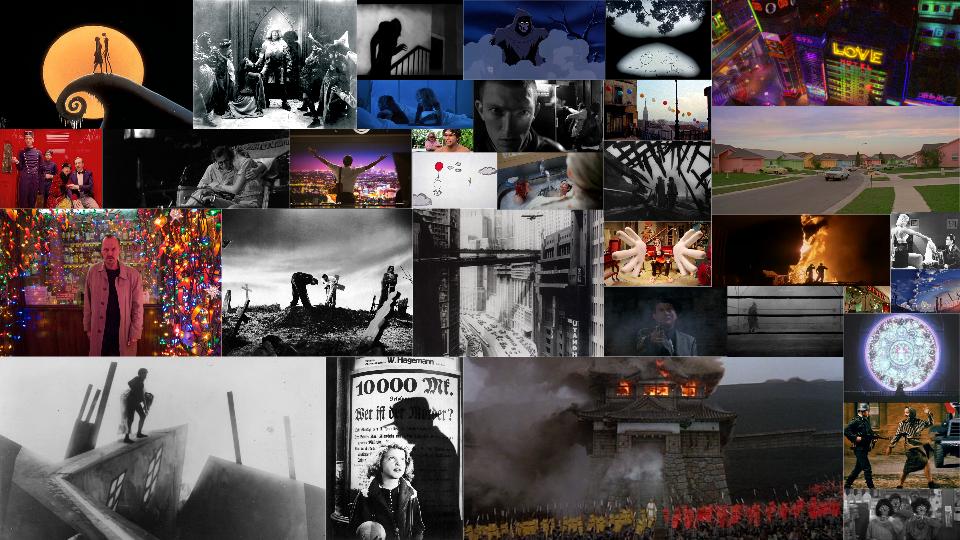
The Nightmare Before Christmas (1993)
Der Golem (1920)
Nosferatu (1922)
Manhunter (1986)
Boogie Nights (1997)
Batman: Curse of the Phantasm (1993)
La Haine (1995)
It's Such a Beautiful Day (2012)
The Red Balloon (1956)
Enter the Void (2010)
The Grand Budapest Hotel (2014)
Manhattan (1979)
Nightcrawler (2014)
Billy's Balloon (1998)
Eternal Sunshine of the Spotless Mind (2004)
Ivan's Childhood (1962)
Edward Scissorhands (1990)
Birdman (2014)
Frankenstein (1931)
Metropolis (1927)
Coraline (2009)
Goodfellas (1990)
There Will Be Blood (2007)
Raging Bull (1980)
Dawn of the Dead (1978)
Ed Wood (1992)
5 Centimetres Per Second (2007)
Cowboy Bebop (1998-1999)
The Cabinet of Dr. Caligari (1920)
M (1931)
Ran (1985)
Life is Beautiful (1997)
They Live (1988)
By Jack D. Phillips
Thursday, 20 August 2015
Hannah and Her Sisters (1986)
 Everything wrong with
Woody Allen as a director
is on display here.
However the
strength of it's cast is
just enough to make it tolerable.
I am a pretty huge fan of Woody Allen as a filmmaker. This makes the fourth film of his that I have seen, and up to this point I have been nothing but impressed. In particular I would consider Manhattan to be one of my favourite films of all time. As a result, it was sad that this film disappointed me so severely. Particularly as this seems to be one of the more well known film of Allen's career. Not only is this undoubtedly the weakest of his films that I have seen, it also showcases all of his most glaring weaknesses as a storyteller.
Although I probably sound harsh at this point, I should make it clear that I do not hate this film. In fact I wouldn't even be able to fully commit to calling bad. This is due almost entirely to the strength of the performances. The cast is incredible, probably the reason why this film has endured as much as it has within the film community, featuring Woody himself, Carrie Fischer, Mia Farrow and Michael Caine amongst other well known talents. Every single performance in this film is strong and in many cases the actors are able to significantly raise the quality of the material that they are given (more about that said material later). I will give particular praise to Michael Caine, for he gives a sensitive and subtle performance and truly lights up the screen with his presence whenever he is shown. It is a shame that Allen film decided to use an ensemble style narrative with this film, as it means Caine's character is reduced to that of a supporting player. If he and Mia Farrow (who is also very strong here) were at the centre of this film's narrative rather than loitering in it's suburbs , it would probably have been for the better.
The film's biggest problem is it's screenplay. I general like Allen's writing style, as he has a very unique and articulate voice and knows how to pace a film narrative well. He is also highly self-conscience, with many of his funniest or most powerful scenes coming from his own critical eye over himself. All of these positive aspects are notably absent from this film, which is self indulgent and, above all else, boring. This film feels at least two or three times it's length, I could literally not believe how short the film was when I checked the back of the DVD. In the end, this tiring and monotonous pace cements the film as mediocre to me. Every strong element that this film offers is lost in the monotony of it's narrative, and that is a real shame. Aside from this perceived length problem, Allen is at his most narcissistic here. His self-deprecating humour is gone here, and without it he becomes quite unlikeable as a performer. Rather than lovable he is annoying, and he is way to prominent in the films overall narrative. I personally feel Allen should have stayed behind the camera for this one.
The film's overwritten script also manages to lessen the effects of the performances at times. There are scenes where we see characters quietly contemplating their situations, the emotional impact of the moment being sold by the expressions on the actors face. For some reason however, Allen decided to overlay these scenes with dull and dense narration, explaining away the emotions that the actors are already conveying visually. This undercuts the effect of these moments and lessened my relation to the people on screen, because the film was not allowing me to interpret anything. This lack of audience involvement, furthers the boredom that the film instils.
I cannot call this film an absolute failure. It was still mildly entertaining and the film has some pretty great moments. Although I have no intention of watching this film again, and I would not recommend it for a moment, it is ultimately harmless and average.
By Jack D. Phillips
A Zoom Film Review
I cannot call this film an absolute failure. It was still mildly entertaining and the film has some pretty great moments. Although I have no intention of watching this film again, and I would not recommend it for a moment, it is ultimately harmless and average.
By Jack D. Phillips
A Zoom Film Review
Monday, 17 August 2015
Duck Amuck (1953)
 Why you should
all know the name
Chuck Jones.
The great Tony Zhou created an excellent video essay on Chuck Jones which I recommend you watch as soon as you finish reading this, but I suppose I should tell you who the guy is first. Chuck Jones was an American animator who basically wrote the book on animated visual comedy. After effectively creating the Looney Toons, he went on to continue topping himself in one of the most remarkable careers in animation history. Although I am yet to revisit What's Opera Doc? which many consider his crowing achievement in comedic storytelling, however for now I feel comfortable in calling Duck Amuck a fairly spectacular achievement in it's own right.
This film is both an excellent example of the comedic style that Jones gave birth to, as well as an intelligent deconstruction of the basic principles of animation. In this short we see Daffy Duck battle against the cartoons animator himself, so the audience is literally watching Jones screwing around with his own creation. Not only is this premise hilarious due to the unexpected nature of it (the short begins as a simple Muskateer themed cartoon), but also because it follows the well established structure of a Daffy Duck cartoon; he is pitted against a more intelligent or powerful opponent and the comedy comes from the constantly increasing anger and frustration of the arrogant character.
This mixing of the expected and unexpected is what makes this short so amazing. We expect to see a silly cartoon in which Daffy is comically abused due to his own flaws and vices, which this short delivers on generously, however we do not expect the omniscience of the director/animator to directly influence the narrative, we especially do not expect this fourth wall breaking to be the driving force of the entire film.The short is also especially funny to those with an interest in filmmaking, as it mixes in some fairly intelligent references to the technical side of cinema and particularly animation.
I cannot describe how Jones is able to make me like Daffy so much, and yet like laughing at his expense so much as the same time. Seeing him desperately attempt to get the narrative that never happens to start is funny in more ways than I can possibly list. The fact that the entire universe that he exists within is being controlled by this entirely uncooperative force is the height of what any Daffy cartoon, and I doubt any other short featuring him can match the conflict seen here.
If you watched Loony Toons as a kid like I did, then I highly recommend revisiting some of Jones' work. I grantee that they exceed your expectations.
By Jack D. Phillips
A Zoom Film Review
Tuesday, 11 August 2015
The Men Who Tread on the Tiger’s Tail (1945)
 Although rather weak
compared to his later
work, this
early period piece shows hints of what would
come for the great artist.
It is fair to say that I am huge fan of director Akira Kurosawa. This however marks my first foray into the director's early work, perhaps the least discussed period of the filmmaker's entire career. Despite being ignored by many, from what I have read almost every film in this period is subject to polarising opinions from fans and critics alike. This film for example has been called Kurosawa's weakest film by Tony Zhou (a Youtube film critic that I am a huge fan of), and one of his best early offerings by Stuart Galbraith IV, the author of a highly extensive biography of the director. So now it is time for me to offer my own thoughts on this polarising film.
For a start it is worth noting that this film was made at the height of the second world war, and as such amidst terrible working/living conditions. This sadly shows in the final film, which was clearly filmed entirely on a fairly cheap sound stage. Furthermore, the audio quality itself is sometimes quite poor. Holding these shaky elements against the film feels unfair, however it does still negatively impact the film's attempt to create an authentic period setting.
To counter the films weak technical elements, it boasts a simple yet elegant screenplay. The story is one of honour, loyalty and the lengths one must go to in order to fulfil their duty. It is a compelling tale, and it held my interest throughout. However this may have been aided by the film's slim running time, so short that I doubt it is even possible to lose interest before the end. I do give the film credit for telling a fairly epic story despite this limit running time, establishing the backstory efficiently in an opening narration and leaving just enough breathing room to establish some personality within the characters, although it is still fairly minimal in the scheme of things. Overall, I feel this film's narrative is one of it's better elements and I praise the film for it's efficient, although far from spectacular, storytelling.
The film's cinematography is quite fantastic in my view. This early in his career Kurosawa had already learned how to keep a film engaging through simple camera moves and story enhancing shot compositions. Alongside the film's phenomenal editing, which is beautifully paced and constantly interesting from start to finish, I would certainly recommend watching this film in particular if you want to know how to enhance a film's impact through cuts and shots alone.
So far I have described some of the film's strongest elements, however things fall apart in when I move onto the subject of the lead performances. For some strange reason, although the narrative has a clearly defined main character, the film adds a comedic relief character
who was not present in the films source material. This character dominates the screen for huge chunks of the film, and I found him insufferable. The actor mugs and overacts in way which I did not even think possible, and is clear to me that Kurosawa did not know how to integrate this guy into the story properly. This comedic character legitimately ruins parts of the film for me, his presence is truly baffling.
Outside of the terrible comedic elements, Denjirô Ôkôchi is excellent as the lead despite being pushed aside, and his ability to hold the viewers eye is really quite remarkable. Furthermore, Takeshi Shimura and Masayuki Mori appear in two very minor roles. They do very little, however it is nice to see two of Kurosawa's greatest collaborators lending their talents in the background. To be bold, one could even call Shimura's performance here a very early prototype to his work on Seven Samurai, as I saw the same gravity and dignity here that made that performance so sublime.
In the end, this film should probably best be remembered as an interesting little experiment from Kurosawa's early career. Many of his talents were honed in this film, and judging by the relative lack of comedic relief in his later films it is safe to assume that the director identified some of his weaknesses. Hardly a masterwork, but still certainly worth seeing for hardcore fans of Kurosawa.
By Jack D. Phillips
A Zoom Film Review
Alone.

Top Left-Bottom Right
The Machinist (2004)
The Master (2012)
The Thing (1982)
There Will Be Blood (2007)
Boogie Nights (1997)
Dead Man Walking (1995)
Ivan;s Childhood (1962)
Dead Man's Shoes (2004)
Red Desert (1964)
Winter's Light (1963)
Drive (2011)
I Saw the Devil (2010)
Attack on Titan (2013)
Psycho (1960)
Cowboy Bebop (1998-1999)
Annie Hall (1977)
The Silence of the Lambs (1991)
Yojimbo (1961)
The Old Dark House (1932)
The Terminator (1984)
Citizen Kane (1941)
Tokyo Story (1953)
Blow Out (1981)
M (1931)
The Meaning of Life (2005)
The Blair Witch Project (1999)
Little Malcolm (1974)
Ringing Bell (1978)
At Midnight I'll take your Soul (1964)
Eternal Sunshine of the Spotless Mind (2004)
The Shining (1980)
Grave of the Fireflies (1988)
By Jack D. Phillips
Friday, 7 August 2015
Failure.

Top Left-Bottom Right
Blow Out (1981)
There Will be Blood (2007)
Boogie Nights (1997)
The Conversation (1973)
Drunken Angel (1948)
Yojimbo (1961)
Plan 9 From Outer Space (1959)
Carrie (1976)
The Wicker Man (1973)
Raging Bull (1980)
Goodfellas (1990)
Ringing Bell (1978)
Whiplash (2014)
Vertigo (1958)
Scarface (1982)
Chinatown (1974)
The Master (2012)
The Empire Strikes Back (1980)
Attack on Titan (2013)
Birdman (2014)
Citizen Kane (1941)
Bad Lieutenant (1992)
Avatar the Last Airbender (2005-2008)
Finding Nemo (2003)
The Red Shoes (1948)
Gone Girl (2014)
The Bad Sleeps Well (1960)
Eternal Sunshine of the Spotless Mind (2004)
By Jack D. Phillips
Monday, 20 July 2015
Character Change.

Top Left- Bottom Right:
Ringing Bell (1978)
Empire of the Sun (1987)
The Godfather (1972)
Brokeback Mountain (2005)
Ikiru (1952)
Summer With Monika (1953)
Avatar the Last Airbender (2005-2008)
Bicycle Thieves (1948)
Goodfellas (1990)
The Terminator (1984)
Tokyo Story (1953)
There Will Be Blood (2007)
Kes (1969)
Pinocchio (1940)
Psycho (1960)
Manhattan (1979)
Oldboy (2003)
Badlands (1973)
A Field in England (2013)
Raging Bull (1980)
Eternal Sunshine of the Spotless Mind (2004)
Boogie Nights (1997)
Carrie (1976)
Little Malcom and his Struggle against the Eunuchs (1974)
Persona (1966)
When the Wind Blows (1986)
Exit through the Gift Shop (2010)
Apocalypse Now (1979)
Schindler's List (1993)
Seven Samurai (1954)
Citizen Kane (1941)
By Jack D. Phillips
Wednesday, 15 July 2015
The Blair Witch Project (1999)
 A flawed and rough
film, however
undeniably effective in it's atmosphere and character building.
This film has been idealised, demonized and mythicised since it's release in 1999. With the possible exception of Scream, there is no other horror film in the past two decades that has been both this influential, and this destructive. This film can both be credited with the creation of a bold new stylistic era of horror filmmaking, found footage, and the birth of a destructive and cliché template for lazy filmmaking, found footage. The genre this film helped to popularise has certainly had a profound, and in my opinion largely negative, impact on the current landscape of western horror. However how does the film itself hold up? Well in my opinion, better than expected.
The film's largest flaw is it's slow and clunky opening. A large amount of time is spent in the hometown of the three main characters and little of substance occurs. These sequences do little to enhance the film's narrative or atmosphere and today are quite boring to watch. The only purpose these scenes have was to contribute to the film's viral marketing campaign, which successfully tricked thousands into believing the events of the film were real. The faux documentary feel of the opening adds credibility to this trickery, however from the perspective of somebody who was not affected by the marketing, these scenes do little other than damage the film's overall pacing.
After this weak start, the film truly begins to unfold. Our three main characters all feel like real people and they are clearly defined from each other. The bulk of the film follows the three amateur filmmakers and their slow descent into madness and terror. Every step of this descent is understandable and the reactions of the characters to their increasingly hostile environment is eerily relatable, to the point where I found myself wondering how I would react in a similar situation. This is the main reason why the film works, we are scared because the characters feel real and are convincingly terrified. Their situation is caused by a mixture of simple incompetence and paranormal interference and I feel there is a conversation to be had about which of those two elements contributed most to their demise. Overall the simple and eerie portrayal of the characters hits home, they feel like people the audience could have genuinely known rather than actors with a script.
The film is also able to achieve incredible things with very little. This is perhaps the most stripped down mode of horror filmmaking imaginable, scaring the audience with sounds, stones and sticks. As described above, the effect is largely achieved due to the strongly defined and well acted characters, however there is also a basic creepiness to these elements. The sounds we hear from within the tent are horrifying and grotesque, the sticks genuinely form occultic and unnerving images and begin to resemble some kinda of abomination of nature. The film's cinematography is at it's strongest as it fetishisticly sweeps over the bundles of twigs suspended in the tress. The iconic symbol that the film spearheaded it's marketicing with is perhaps the strongest example of this eerie imagery.
Overall I would call this film a near masterpiece. My enjoyment is somewhat tainted by the scourge of largely inferior found footage knockoffs which followed, along with the undeniably weak opening ten minutes. However if you are able to look past these hindrances, you will find a powerful and still largely unique horror experience.
By Jack D. Phillips
A Zoom Film Review
Sunday, 12 July 2015
Minions (2015)

An intensely funny
animated romp
through one of my
favourite periods
in modern history.
It is sad to see the length to which Universal's corporate scumbags have gone to ruin my enjoyment of this film. It's disgusting over-marketing, the intense focus on brand awareness and the appearance of the minions in literally countless advertising campaigns. These little guys have been packaged, sold and forced into every cranny of the media and I swear to have seen some reference to the franchise in every film I have seen in the past seven-eight months. It makes it very hard for me to recommend this film, because I do not blame people for being burnt out and irritated with the entire ordeal.
Recommend it I do however, for I feel this is one of the funniest films to have been released in the past few years. It is clever, fast and was basically everything I could have wanted from a family oriented comedy. It was a genuinely a wonderful surprise. I am not sure if I would call this or Cinderella the biggest surprise of the year, but 2015 is shaping up to be a year of broken expectations for me, in a good way.
So why does this film work? By far the biggest component of it's success is the animation. The visuals are always moving, always preparing for a new joke while the current one plays out. It never feels like there is a comedy dead spot or a missed opportunity for humour and literally every frame works to either deliver or set-up a joke. The comedy very much follows the Looney Toons methodology, and the same mixture of slapstick and verbal humour combined. Minions takes the formula further however, as the budget allows for dozens of clever visual jokes to crammed seamlessly into the background. I want to re-watch this film solely so I can hunt these background gags down one by one.
The film also has amazing comic timing. The slapstick in this film is of the highest quality, sold with excellent sound mixing, and the speed of the character's expressions is remarkable. Sandra Bullock and John Hamm's characters Scarlett and Herb Overkill are the best examples of this. They move and react so quickly and with such detail on top of both actor's exceptional vocal comedic timing, that I am prepared to call them the funniest characters I have seen in any recently released animated film. They are that hilarious.
Can I also point out how refreshing it is to get a funny female villain who is not in any way subservient to a male character, and is also not portrayed as some kind of incomplete, single woman scorned by men? It is actually hard to think of many female villains who are not subservient to a man, and yet are also in a relationship. Seems like a weird thing to pick up on, but it was a refreshing thing to see, and it is also sad that I have not seen that particular character set-up more often.
The titular minions are also highly amusing, with the film being led by three characterised minions. They offer up a lot of great slapstick and Pierre Coffin is great as always in the role. I have to give him huge credit for giving the three leads such distinct, funny and likeable personalities simultaneously whilst also keeping the core minion humour and traits present within them all. This is all done without coherent dialogue by the way. I cannot imagine how much work this must have been and give the the man (who is should point out also co-directed the film by the way!) all the credit I can for what he has achieved largely single handed in this film. His work here is truly staggering.
Possibly my most subjective positive about this film is it's setting. I adore the late 60's and find the pop culture and iconography of the period so enjoyable. I can tell that the filmmakers share this love with me, and they go totally bananas and submerge the film entirely in the setting. Much like how the film never misses a chance to do something funny, it also takes every opportunity it can to crack a joke or make a reference to the period. It does this through the excellent soundtrack, with many of my favourite tunes of the day, the aforementioned background humour and the surprisingly funny dialogue for the human characters. The film also shows surprising restraint in this department, playing it's big period jokes carefully and never over-saturating things. For example, The Beatles, Nixon, the moon landing and so many other period defining topics are only used once each, and all of these jokes are incredibly funny because of this restraint.
There are some minor flaws however. Not every joke works, and although the film's quick pace is able to sweep most of these groaners up without them lingering, it would still be unfair to say that every joke is funny. Also, the actual plot-line is weak and fairly ridiculous. This does not matter much do to the film's clear focus on comedy above plot, however it would still have been nice to get a strong and unpredictable narrative alongside our comedy.
Overall, this film is a true joy. Go see it if you can and don't let the obnoxious marketing discourage you. It is annoying, and I hate to support such egregious business tactics, however letting such a gem of a comedy pass you by would be far worse.
By Jack D. Phillips
A Zoom Film Review
Recommend it I do however, for I feel this is one of the funniest films to have been released in the past few years. It is clever, fast and was basically everything I could have wanted from a family oriented comedy. It was a genuinely a wonderful surprise. I am not sure if I would call this or Cinderella the biggest surprise of the year, but 2015 is shaping up to be a year of broken expectations for me, in a good way.
So why does this film work? By far the biggest component of it's success is the animation. The visuals are always moving, always preparing for a new joke while the current one plays out. It never feels like there is a comedy dead spot or a missed opportunity for humour and literally every frame works to either deliver or set-up a joke. The comedy very much follows the Looney Toons methodology, and the same mixture of slapstick and verbal humour combined. Minions takes the formula further however, as the budget allows for dozens of clever visual jokes to crammed seamlessly into the background. I want to re-watch this film solely so I can hunt these background gags down one by one.
The film also has amazing comic timing. The slapstick in this film is of the highest quality, sold with excellent sound mixing, and the speed of the character's expressions is remarkable. Sandra Bullock and John Hamm's characters Scarlett and Herb Overkill are the best examples of this. They move and react so quickly and with such detail on top of both actor's exceptional vocal comedic timing, that I am prepared to call them the funniest characters I have seen in any recently released animated film. They are that hilarious.
Can I also point out how refreshing it is to get a funny female villain who is not in any way subservient to a male character, and is also not portrayed as some kind of incomplete, single woman scorned by men? It is actually hard to think of many female villains who are not subservient to a man, and yet are also in a relationship. Seems like a weird thing to pick up on, but it was a refreshing thing to see, and it is also sad that I have not seen that particular character set-up more often.
The titular minions are also highly amusing, with the film being led by three characterised minions. They offer up a lot of great slapstick and Pierre Coffin is great as always in the role. I have to give him huge credit for giving the three leads such distinct, funny and likeable personalities simultaneously whilst also keeping the core minion humour and traits present within them all. This is all done without coherent dialogue by the way. I cannot imagine how much work this must have been and give the the man (who is should point out also co-directed the film by the way!) all the credit I can for what he has achieved largely single handed in this film. His work here is truly staggering.
Possibly my most subjective positive about this film is it's setting. I adore the late 60's and find the pop culture and iconography of the period so enjoyable. I can tell that the filmmakers share this love with me, and they go totally bananas and submerge the film entirely in the setting. Much like how the film never misses a chance to do something funny, it also takes every opportunity it can to crack a joke or make a reference to the period. It does this through the excellent soundtrack, with many of my favourite tunes of the day, the aforementioned background humour and the surprisingly funny dialogue for the human characters. The film also shows surprising restraint in this department, playing it's big period jokes carefully and never over-saturating things. For example, The Beatles, Nixon, the moon landing and so many other period defining topics are only used once each, and all of these jokes are incredibly funny because of this restraint.
There are some minor flaws however. Not every joke works, and although the film's quick pace is able to sweep most of these groaners up without them lingering, it would still be unfair to say that every joke is funny. Also, the actual plot-line is weak and fairly ridiculous. This does not matter much do to the film's clear focus on comedy above plot, however it would still have been nice to get a strong and unpredictable narrative alongside our comedy.
Overall, this film is a true joy. Go see it if you can and don't let the obnoxious marketing discourage you. It is annoying, and I hate to support such egregious business tactics, however letting such a gem of a comedy pass you by would be far worse.
By Jack D. Phillips
A Zoom Film Review
Subscribe to:
Posts (Atom)